Real Estate & Community News

Sept. 2, 2021

Hello September!

May be an image of sky, body of water and text


🍁🍂 Happy September! The fall gives a new start to our daily routines, a fresh slate…Back to school schedules, fall schedules rather than our summer schedules, fall sports, fall cleaning, Home selling, purging and football! 🏈 September is the gateway to all the BEST holidays and the most wonderful time of the year🎃🦃🎄Fall brings apple picking, pumpkin picking, sunflower picking, the Big E, gatherings, bonfires, Halloween parties and most importantly, Christmas Blessings. 🍂🍁🎃🦃🎄


Posted in Real Estate News
Sept. 1, 2021

Today’s Real Estate Market Explained Through 4 Key Trends

Today’s Real Estate Market Explained Through 4 Key Trends

As we move into the second half of the year, one thing is clear: the current real estate market is one for the record books. The exact mix of conditions we have today creates opportunities for both buyers and sellers. Here’s a look at four key components that are shaping this unprecedented market.

A Shortage of Homes for Sale

Earlier this year, the number of homes available for sale fell to an all-time low. In recent months, however, inventory levels are starting to trend up. The latest Monthly Housing Market Trends Report from realtor.com says:

“In June, newly listed homes grew by 5.5% on a year-over-year basis, and by 10.9% on a month-over-month basis. Typically, fewer newly listed homes appear on the market in the month of June compared to May. This year, growth in new listings is continuing later into the summer season, a welcome sign for a tight housing market.”

This is good news for buyers who crave more options. But even though we’re experiencing small gains in the number of available homes for sale, inventory remains a challenge in most states. That’s why it’s still a sellers’ market, giving homeowners immense leverage when they decide to make a move.

Buyer Competition and Bidding Wars

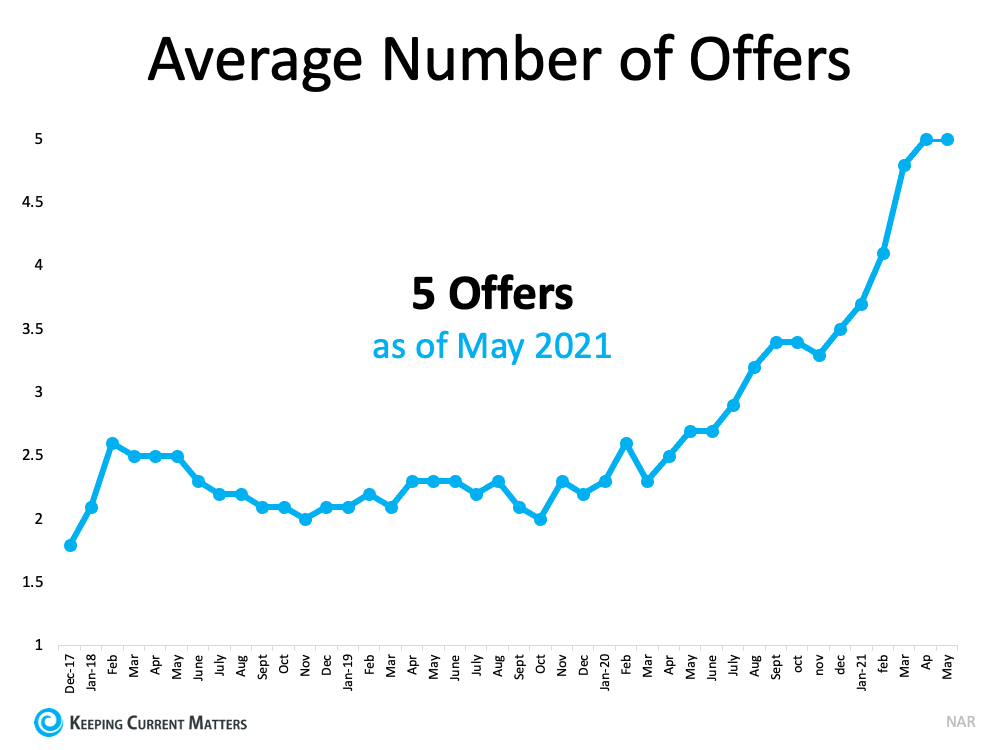
Today’s ongoing low supply, coupled with high demand, creates a market characterized by high buyer competition and bidding wars. Buyers are going above and beyond to make sure their offer stands out from the crowd by offering over the asking price, all cash, or waiving some contingencies. The number of offers on the average house for sale broke records this year – and that’s great news for sellers.

The latest Confidence Index from the National Association of Realtors (NAR) says the average home for sale receives five offers (see graph below):Today’s Real Estate Market Explained Through 4 Key Trends | Keeping Current MattersFor buyers, the best way to put a compelling offer together is by working with a local real estate professional. That agent can act as your trusted advisor on what terms are best for you and what’s most appealing to the seller.

Home Price Appreciation

The competition among buyers is driving prices up. Over the past year, we’ve seen home price appreciation rise across the country. According to the most recent Home Price Index (HPI) from CoreLogic, national home prices increased 15.4% year-over-year in May:

“The May 2021 HPI gain was up from the May 2020 gain of 4.2% and was the highest year-over-year gain since November 2005. Low mortgage rates and low for-sale inventory drove the increase in home prices.”

Rising home values are a big part of why real estate remains one of the top sought-after investments for Americans. For potential sellers, it also means it’s a great time to list your house to maximize the return on your investment.

A Rise in Home Values and Equity

The equity in a home doesn’t just grow when a homeowner pays their mortgage – it also grows as the home’s value appreciates. Thanks to the jump in price appreciation, homeowners across the country are seeing record-breaking gains in home equity. CoreLogic recently reported:

“…homeowners with mortgages (which account for roughly 62% of all properties) have seen their equity increase by 19.6% year over year, representing a collective equity gain of over $1.9 trillion, and an average gain of $33,400 per borrower, since the first quarter of 2020.”

That’s a major perk for households to leverage. Homeowners can use that equity to accomplish major life goals or move into their dream homes.


Posted in Market Updates
Aug. 31, 2021

Coming Soon to Chicopee!

May be an image of 1 person, outdoors and text that says 'Coming Soon! LIVE9/1 9/1 LIVE Open House SATURDAY 9/4 11:00 AM 1:00 PM Brenda Cuoco 180 Beauchamp Terrace U:4 Associates Real Estate Brokerage Chicopee, MA #teamCUOCO With Brenda Cuoco'


⭐Coming Soon to Chicopee! ⭐

Why Rent? When you can buy this LOVELY townhouse!😍

Absolutely Beautiful Renovated (2015) Kitchen offers cabinetry, granite counter tops, backsplash, and all appliances, fresh paint and wood laminate flooring. Living rm/dining rm combo has wood laminate flooring- just perfect for entertaining!

🗝️Open House Saturday- September 4th from 11:00 AM - 12:30 PM with Angela Flori & Rebecca Impionbato!

Join us at the Open House or call our office for more details! 📞(413)-333-7776

Aug. 30, 2021

Pop Quiz: Can You Define These Key Terms in Today’s Housing Market?

Pop Quiz: Can You Define These Key Terms in Today’s Housing Market? [INFOGRAPHIC] | Keeping Current Matters

Aug. 29, 2021

186 Lyon - Price Improvement!

May be an image of 1 person, grass, tree and text that says 'Price Improvement! AT LISTED 000 NOW 5950000 $560,000 $560. Open House Saturday 9/4 11:00AM 12:30PM Brenda Cuoco &Associates Real Estate Brokerage #teamCUOCO 186 Lyon Street Ludlow. MA'


💥 PRICE IMPROVEMENT – NOW $560,000💥

📍 186 Lyon Street Ludlow, MA 01056

Standout Features Include:
🤩 Farmer's Porch
✨ Expansive Living Room
🌟 Outdoor Entertainment

🗝️Join us at the Open House Saturday September 4th from 11:00 AM - 12:30 PM with Kathleen Brenner! Can‘t make the Open House? Call Kathleen for more details! (413)-433-0290📱


Aug. 27, 2021

Remote Work Has Changed Our Home Needs. Is It Time for Your Home To Change, Too?

Remote Work Has Changed Our Home Needs. Is It Time for Your Home To Change, Too?


Over the past year, many homeowners realized what they need in a home is changing, especially with the rise in remote work. If you’re longing for a dedicated home office or a change in scenery, now may be the time to find the home that addresses your evolving needs.

Working from Home Isn’t a Passing Fad

Before the pandemic, only 21% of individuals worked from home. However, if you’ve recently discovered remote work is your new normal, you’re not alone.

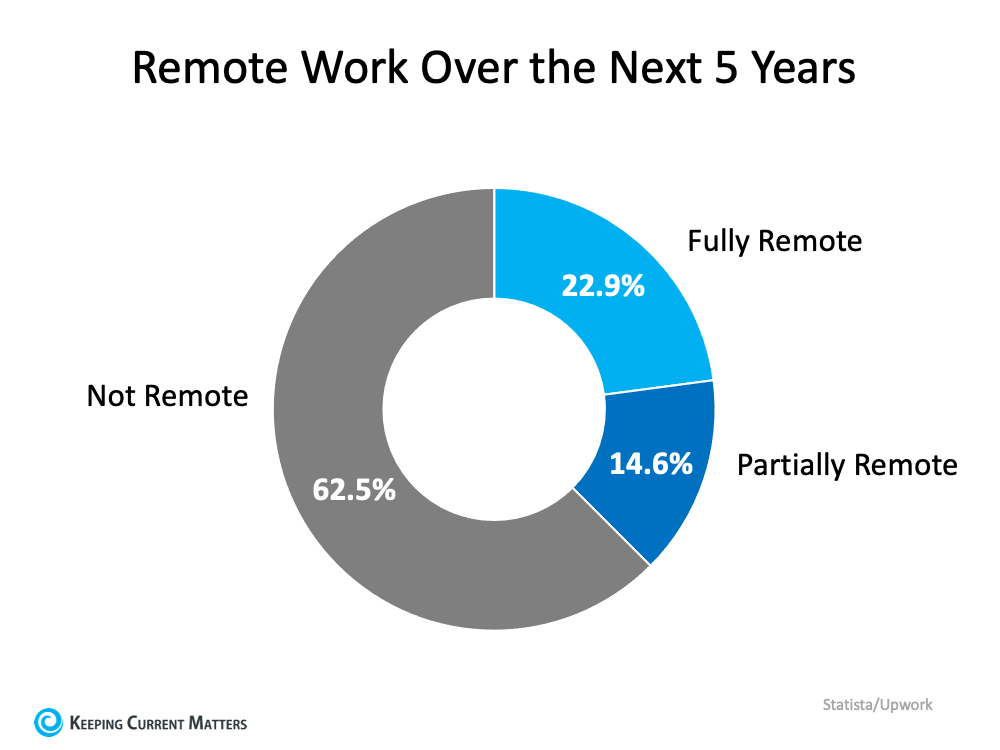
A survey of hiring managers conducted by Statista and Upwork projects 37.5% of U.S. workers will work remotely in some capacity over the next 5 years (see chart below):Remote Work Has Changed Our Home Needs. Is It Time for Your Home To Change, Too? | Keeping Current Matters

Working from Home Gives You More Flexibility and More Options

If you fall in that category, working from home may provide you with opportunities you didn’t realize you had. The ongoing rise in remote work means a portion of the workforce no longer needs to be tied to a specific area for their job. Instead, it gives those workers more flexibility when it comes to where they can live.

If you’re one of the nearly 23% of workers who will remain 100% remote, you have the option to move to a lower cost-of-living area or to the location of your dreams. If you search for a home in a more affordable area, you’ll be able to get more house for your money, freeing up more options for your dedicated office space and more breathing room. You could also move to an area you’ve always dreamed of vacationing in – somewhere near the beach, the mountains, or simply an area that features better weather and community amenities. Without your job tying you to a specific location, you’re bound to find your ideal spot.

If you’re one of the almost 15% of individuals who will have a partially remote or hybrid schedule, relocating within your local area to a home that’s further away from your office could be a great choice. Since you won’t be going into work every day, a slightly longer commute from a more suburban or rural area could be a worthy trade-off for a home with more features, space, or comforts. After all, if you’ll still be at home part-time, why not find a home that better suits your needs?

According to the latest Top Ten Issues Affecting Real Estate from The Counselors of Real Estate (CRE), many homebuyers are already taking advantage of their newfound flexibility:

“. . . after years of apparent but variant trends towards urbanization, the pandemic universally caused a movement away from urban cores, particularly for those with higher incomes who could afford to move and for lower-income individuals seeking lower costs of living.”

Bottom Line

Aug. 25, 2021

Diving Deep into Today’s Biggest Buyer Concerns

Diving Deep into Today’s Biggest Buyer Concerns

Last week, Fannie Mae released their Home Purchase Sentiment Index (HPSI). Though the survey showed 77% of respondents believe it’s a “good time to sell,” it also confirms what many are sensing: an increasing number of Americans believe it’s a “bad time to buy” a home. The percentage of those surveyed saying it’s a “bad time to buy” hit 64%, up from 56% last month and 38% last July.

The latest HPSI explains:

“Consumers also continued to cite high home prices as the predominant reason for their ongoing and significant divergence in sentiment toward homebuying and home-selling conditions. While all surveyed segments have expressed greater negativity toward homebuying over the last few months, renters who say they are planning to buy a home in the next few years have demonstrated an even steeper decline in homebuying sentiment than homeowners. It’s likely that affordability concerns are more greatly affecting those who aspire to be first-time homeowners than other consumer segments.”

Let’s look closely at the market conditions that impact home affordability.

A mortgage payment is determined by the price of the home and the mortgage rate on the loan used to purchase it. Lately, monthly mortgage payments have gone up for buyers for two key reasons:

  1. Mortgage rates have increased from 2.65% this past January to 2.9%.
  2. Home prices have increased by 15.4% over the last 12 months.

Based on these rising factors, a home may be less affordable today, but it doesn’t mean it’s not affordable.

Three weeks ago, ATTOM Data released their second-quarter 2021 U.S. Home Affordability Report which explained that the major ownership costs on the typical home as a percent of the average national wage had increased from 22.2% in the second quarter of 2020 to 25.2% in the second quarter of this year. They also went on to explain:

“Still, the latest level is within the 28 percent standard lenders prefer for how much homeowners should spend on mortgage payments, home insurance and property taxes.”

In the same report, Todd Teta, Chief Product Officer with ATTOM, confirms:

“Average workers across the country can still manage the major expenses of owning a home, based on lender standards.”

It’s true that monthly mortgage payments are greater than they were last year (as the ATTOM data shows), but they’re not unaffordable when compared to the last 30 years. While payments have increased dramatically during that several-decade span, if we adjust for inflation, today’s mortgage payments are 10.7% lower than they were in 1990.

What’s that mean for you? While you may not get the homebuying deal someone you know got last year, that doesn’t mean you shouldn’t still buy a home. Here are your alternatives to buying and the trade-offs you’ll have with each.

Alternative 1: I’ll rent instead.

Some may consider renting as the better option. However, the monthly cost of renting a home is skyrocketing. According to the July National Rent Report from Apartment List:

“…So far in 2021, rental prices have grown a staggering 9.2%. To put that in context, in previous years growth from January to June is usually just 2 to 3%. After this month’s spike, rents have been pushed well above our expectations of where they would have been had the pandemic not disrupted the market.”

If you continue to rent, chances are your rent will keep increasing at a fast pace. That means you could end up spending significantly more of your income on your rental as time goes on, which could make it even harder to save for a home.

Alternative 2: I’ll wait it out.

Others may consider waiting for another year and hoping that purchasing a home will be less expensive then. Let’s look at that possibility.

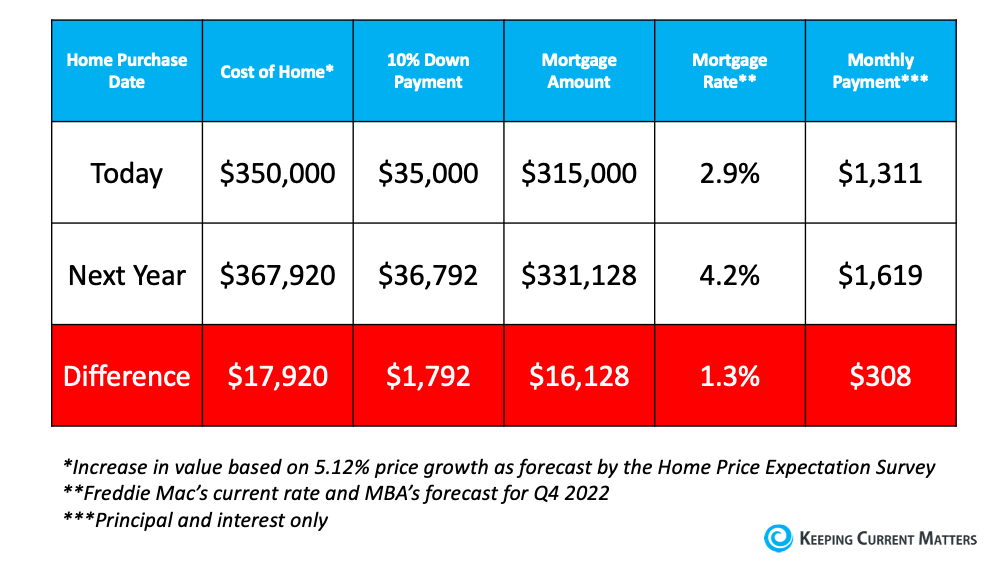
We’ve already established that a monthly mortgage payment is determined by the price of the home and the mortgage rate. A lower monthly payment would require one of those two elements to decrease over the next year. However, experts are forecasting the exact opposite:

  • The Mortgage Bankers Association (MBA) projects mortgage rates will be at 4.2% by the end of next year.
  • The Home Price Expectation Survey (HPES), a survey of over 100 economists, investment strategists, and housing market analysts, calls for home prices to increase by 5.12% in 2022.

Based on these projections, let’s see the possible impact on a monthly mortgage payment:Diving Deep into Today’s Biggest Buyer Concerns | Keeping Current MattersBy waiting until next year, you’d potentially pay more for the home, need a larger down payment, pay a higher mortgage rate, and pay an additional $3,696 each year over the life of the mortgage.
 

July 31, 2021

Top Reasons To Own Your Home [INFOGRAPHIC]

Top Reasons To Own Your Home [INFOGRAPHIC] | Keeping Current Matters

Posted in For Buyers, For Sellers
July 28, 2021

What To Expect as Appraisal Gaps Grow

What To Expect as Appraisal Gaps Grow


In today’s real estate market, low inventory and high demand are driving up home prices. As many as 54% of homes are getting offers over the listing price, based on the latest Realtors Confidence Index from the National Association of Realtors (NAR). Shawn Telford, Chief Appraiser at CoreLogic, elaborates:

“The frequency of buyers being willing to pay more than the market data supports is increasing.”

While this is great news for today’s sellers, it can be tricky to navigate if the price of your contract doesn’t match up with the appraisal for the house. It’s called an appraisal gap, and it’s happening more in today’s market than the norm.

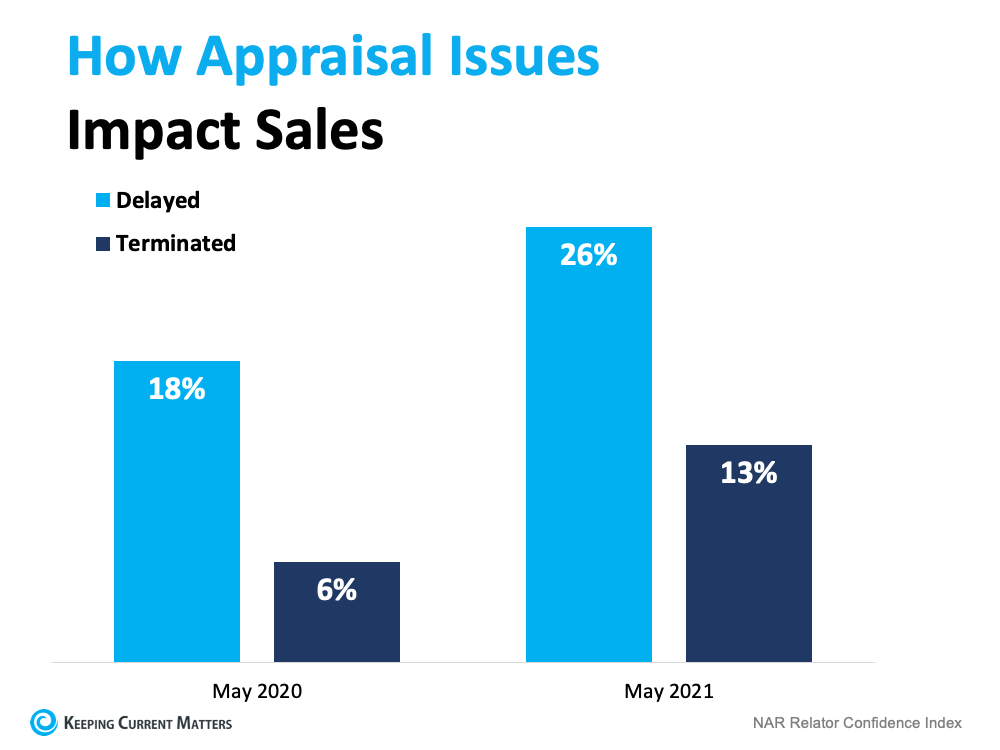
According to recent data from CoreLogic, 19% of homes had their appraised value come in below the contract price in April of this year. That’s more than double the percentage in each of the two previous Aprils.

The chart below uses the latest insights from NAR’s Realtors Confidence Index to showcase how often an issue with an appraisal slowed or stalled the momentum of a house sale in May of this year compared to May of last year.What To Expect as Appraisal Gaps Grow | Keeping Current MattersIf an appraisal comes in below the contract price, the buyer’s lender won’t loan them more than the house’s appraised value. That means there’s going to be a gap between the amount of loan the buyer can secure and the contract price on the house.

In this situation, both the buyer and seller have a vested interest in making sure the sale moves forward with little to no delay. The seller will want to make sure the deal closes, and the buyer won’t want to risk losing the home. That’s why it’s common for sellers to ask the buyer to make up the difference themselves in today’s competitive market.

July 26, 2021

Homebuyers: Hang in There [INFOGRAPHIC]

Homebuyers: Hang in There [INFOGRAPHIC] | Keeping Current Matters


Posted in For Buyers