
Have you seen Brenda's Interview on Western Mass News? Check it out!
*Based on information provided to and compiled by MLS Property Information Network, Inc. & SmartMLS covering the period 08/01/2021-08/31/2021.


🤩 Check out Your Longmeadow Real Estate August Market Report! 🤩
🤔 Curious what your home is worth?
.jpg)
One of the hottest topics of conversation in today’s real estate market is the shortage of available homes. Simply put, there are many more potential buyers than there are homes for sale. As a seller, you’ve likely heard that low supply is good news for you. It means your house will get more attention, and likely, more offers. But as life begins to return to normal, you may be wondering if that’s something that will change.
While it may be tempting to blame the pandemic for the current inventory shortage, the pandemic can’t take all the credit. While it did make some sellers hold off on listing their houses over the past year, the truth is the low supply of homes was years in the making. Let’s take a look at the root cause and what the future holds to uncover why now is still a great time to sell.
It’s not just today’s high buyer demand. Our low supply goes hand-in-hand with the number of new homes built over the past decades. According to Sam Khater, VP and Chief Economist at Freddie Mac:
“The main driver of the housing shortfall has been the long-term decline in the construction of single-family homes.”
Data in a recent report from the National Association of Realtors (NAR) tells the same story. New home construction has been lagging behind the norm for quite some time. Historically, builders completed an average of 1.5 million new housing units per year. However, since the housing bubble in 2008, the level of new home construction has fallen off (see graph below):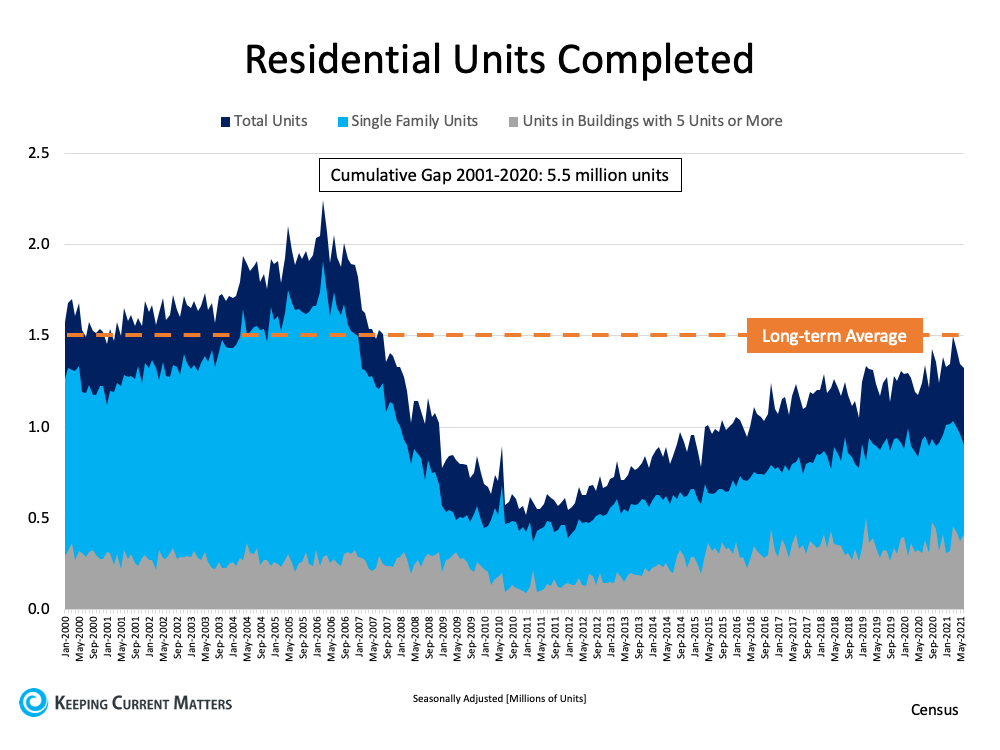 The same NAR report elaborates on the impact of this below-average pace of construction:
“. . . the underbuilding gap in the U.S. totaled more than 5.5 million housing units in the last 20 years.”
“Looking ahead, in order to fill an underbuilding gap of approximately 5.5 million housing units during the next 10 years, while accounting for historical growth, new construction would need to accelerate to a pace that is well above the current trend, to more than 2 million housing units per year. . . .”
That means if we build even more new houses than the norm every year, it’ll still take a decade to close the underbuilding gap contributing to today’s supply-and-demand mix. Does that mean today’s ultimate sellers’ market is here to stay?
We’re already starting to see an increase in new home construction, which is great news. But newly built homes can’t bridge the supply gap we’re facing right now on their own. In the State of the Nation’s Housing 2021 Report, the Joint Center for Housing Studies of Harvard University (JCHS) says:
“…Although part of the answer to the nation’s housing shortage, new construction can only do so much to ease short-term supply constraints. To meet today’s strong demand, more existing single-family homes must come on the market.”
When we look at existing homes, the latest reports signal that housing supply is growing gradually month-over-month. This uptick in existing homes for sale shows things are beginning to shift. Based on recent data, Odeta Kushi, Deputy Chief Economist at First American, has this to say:
“It looks like existing inventory is starting to inch up, which is good news for a housing market parched for more supply.”
Lawrence Yun, Chief Economist at NAR, echoes that sentiment:
“As the inventory is beginning to pick up ever so modestly, we are still facing a housing shortage, but we may have turned a corner.”
So, what does all of this mean for you? Just because life is starting to return to normal, it doesn’t mean you missed out on the best time to sell. It’s not too late to take advantage of today’s sellers’ market and use rising equity and low interest rates to make your next move.
If you’re a prospective buyer or seller, it’s important to understand the current real estate market conditions and how they affect you. The Counselors of Real Estate (CRE) just released its Top Ten Issues Affecting Real Estate report. Here are three hot topics from the list and how they impact today’s housing market.
The past year ushered in many changes to the real estate industry, especially when it comes to technology. The CRE report elaborates on this:
“Lockdown-driven changes in our work, in the economy, in social structures, and in our personal behavior have pushed our reluctance aside. The acceleration and adoption of technology during the pandemic has impacted everything, and real estate is no exception.”
For real estate, innovations like digital documentation, virtual tours, and video chat enable agents to connect with clients no matter their location. These options are ideal for prospective buyers and sellers who aren’t local to the area or those that need the added flexibility signing documents online or doing virtual tours provide. That’s why many trusted real estate advisors will continue to use these technologies moving forward to best serve their clients.
Working from home became the reality for many individuals during the pandemic, and the latest list from the CRE identified remote work and mobility as an important influence on the real estate market. As the report notes:
“…the pandemic universally caused a movement away from urban cores, particularly for those with higher incomes who could afford to move and for lower-income individuals seeking lower costs of living. Most of these relocations remained within their original region—84%—and, while some are returning, it is unknown as to the permanence of these movements or whether they represent a true urban exodus.”
With the added mobility remote work offers, where people are moving and where they can ultimately purchase a home is less dependent on a physical office location. This newfound flexibility is giving remote workers the opportunity to move to more affordable areas and buy more home for their money.
Finally, the limited supply of houses for sale and the related affordability challenges also makes CRE’s list of key factors this year:
“According to the National Association of Realtors®, the state of America’s housing inventory is dire, with a chronic shortage of affordable and available homes needed to support the nation’s population.”
There is good news. Homes are still more affordable than they have been historically thanks to today’s low mortgage rates. And while housing supply is still low, we’re seeing steady increases in the number of homes coming to market, which gives hope to homebuyers. As the supply of homes for sale improves, buyers will have more options.
⭐Coming Soon to Springfield! ⭐
Charming!😍 Fantastic first floor layout featuring an oversized living room and a spacious, fully applianced kitchen with plenty of counter space that leads out to a lovely three season porch, great for entertaining! Rounding out the first floor is a convenient half bath and a full dining room with large closet that could also be used as a third bedroom!
🗝️Open House Saturday, September 11th from 11:00 AM - 12:30 PM with Maria Serrano & Tammy Sandomierski!
Join us at the Open House or call Pam for more details! 📞(413)-544-1366
🤔 Curious what your home is worth?
https://www.wmasshomebuyer.com/cma/property-valuation/

![Waiting To Buy a Home Could Cost You [INFOGRAPHIC] | Keeping Current Matters](https://files.keepingcurrentmatters.com/wp-content/uploads/2021/07/29150933/20210723-NM-1.png)
![Sellers Are in a Sweet Spot [INFOGRAPHIC] | Keeping Current Matters](https://files.keepingcurrentmatters.com/wp-content/uploads/2021/08/12133154/20210806-NM-1.png)